
The Downfall of Derek H.: A Dark Web Counterfeit Scheme Revealed
You may assume that a bill accepted by an ATM has passed every check. Derek H.’s case shows why that assumption failed.
Published: — Last reviewed: Oct 2, 2026 — By: Derek Mason
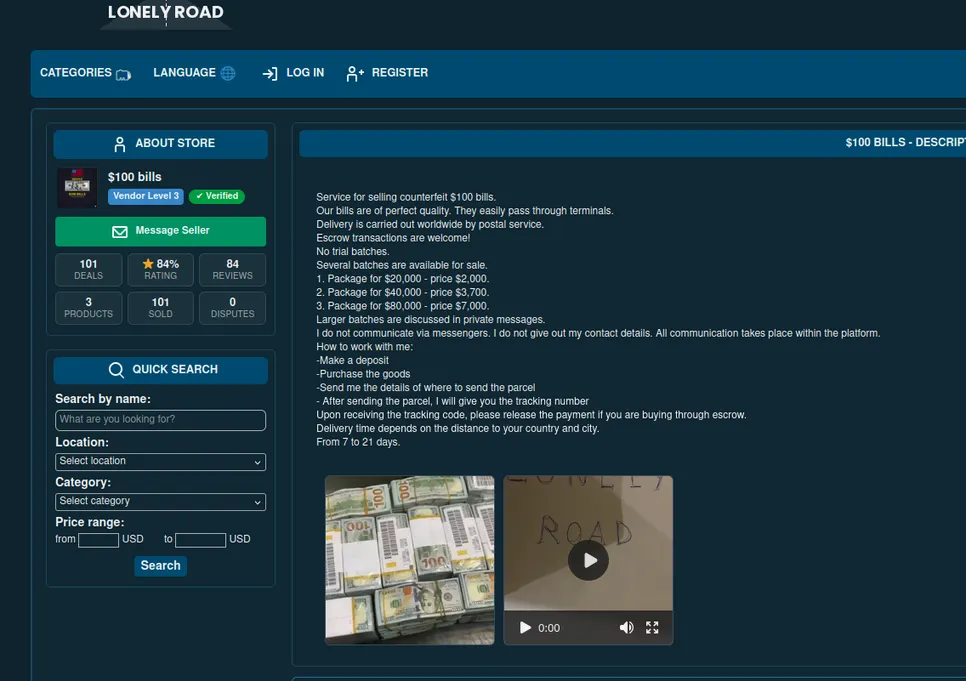
You should treat the website where the purchase was made as part of the evidence, not proof that the seller’s promises were true.
Derek, a 29-year-old Denver, Colorado, resident, believed he had found a simple way to convert counterfeit paper into money on his bank balance. To see where the plan collapsed, you need to compare the seller’s claims with the ATM results, the bank’s response, and the arrest that followed.
What matters
- You should not treat ATM acceptance as final approval.
- Derek paid $1,200 for 40 counterfeit $100 bills.
- Only $800 was initially credited by the first two ATMs.
- The bank froze his account the next morning.
- Secret Service agents arrested him three weeks later.
- Start With the January 2025 Purchase
In January 2025, Derek used cryptocurrency to pay $1,200 for 40 counterfeit $100 bills from the 2009 series. He obtained them through a darknet marketplace.
The listing promoted “superdollar quality.” You were meant to believe that each fake 100 dollar note looked identical to genuine currency and included a working watermark, UV protection, and magnetic strip.
Search labels such as fake money darknet, fake money site, buy fake dollars, fake dollar price, and 100 dollar fake money may suggest an ordinary retail transaction. In this case, however, the purchase involved counterfeit currency and a seller’s unverified promises—not prop money dollars intended merely to resemble cash.
- Reconstruct the Deposit Plan
Derek planned to feed the bills into cash-accepting ATMs. You can follow his assumption easily: the machine would read the paper, credit his account, and leave him with “digital” dollars that he could withdraw or transfer.
He was not trying to locate prop money for sale nearby or purchase theatrical notes. His batch consisted of fake money dollar bills presented as genuine currency, specifically counterfeit $100 dollar bill examples rather than counterfeit $20 dollar bills.
Phrases such as buy counterfeit 20 dollar bills and realistic fake money australia do not describe this case. You should keep them separate from the documented facts: Denver, 40 notes, $100 denominations, the 2009 series, and a $1,200 cryptocurrency payment.
- Track Each ATM Result
The initial activity may have reinforced Derek’s confidence, but an ATM’s temporary acceptance does not guarantee final bank clearance—just as a processing card payment can still be reversed. The sequence is summarized below.
ATM step Machine action Logged outcome ATM at third stop Ejected one bill An error appeared onscreen ATM at fourth stop Took the bill Txn. labeled “pending review” Initial two ATMs Took the bills without an instant rejection Derek’s acct. received an $800 credit The contrast matters. Two machines initially accepted part of the batch, while the next two interactions produced an error and a review flag, so the supposed “superdollar quality” did not deliver the seamless result Derek expected.
- Follow the Bank Freeze and Arrest
The morning after the fourth ATM transaction, the bank froze Derek’s account. You can therefore identify the review flag as the last recorded warning before access to the account was blocked.
Three weeks later, the U.S. Secret Service arrested him. The source does not provide laboratory findings, surveillance details, communications with the marketplace seller, or the bank’s internal detection process, so you should not invent those missing steps.
What the record does show is narrower: ATM acceptance did not settle the deposits permanently, one note was rejected, another transaction entered review, the account was frozen the next morning, and federal agents made the arrest three weeks later.
- Separate the Sales Pitch From the Outcome
A person searching fake counterfeit money may assume that security-feature claims guarantee success. You should compare that assumption with the actual sequence rather than with the listing language.
The seller claimed visual indistinguishability, UV protection, a magnetic strip, and a watermark. Yet the documented outcome was an ATM error, a pending review, a frozen bank account, and an arrest—not a completed conversion of all 40 bills into usable account funds.
The source does not reveal what happened to every remaining bill or whether Derek withdrew or transferred any of the credited $800. You can only conclude that his broader plan failed and that initial ATM acceptance did not prevent later scrutiny.
Reject the ATM-Approval Myth
You should read this case as a test of a specific claim, not as proof that a counterfeit note becomes legitimate once a machine accepts it. Derek relied on the seller’s description and the first two ATM results, but the third and fourth machines changed the sequence from apparent success to review.
The final timeline is direct: purchase in January 2025, partial ATM acceptance, an error, a pending review, an account freeze the next morning, and a Secret Service arrest three weeks later.
FAQ
- What did Derek buy?
You can identify the purchase as 40 counterfeit $100 bills from the 2009 series. He paid $1,200 in cryptocurrency on a darknet marketplace.
- Did the ATMs accept the counterfeit bills?
You can see that the first two ATMs accepted bills and credited $800. The third returned a note with an error, while the fourth accepted one but marked the transaction as pending review.
- When did the bank freeze the account?
You can place the freeze on the morning after the fourth ATM transaction. The source does not describe the bank’s internal review methods.
- How long passed before Derek was arrested?
You can trace the arrest to three weeks after the account freeze. The U.S. Secret Service arrested Derek.
Read next
- Directory of Reliable Onion Services You Can Access in Tor — Review six Tor services, what each one offers, and how you can verify official onion addresses before opening them in Tor Browser.
 Finding Hidden Wiki Links on Reddit: A Step-by-Step Guide — Discover how to find hidden wiki links on Reddit safely and efficiently, ensuring your browsing remains secure and your data protected.